
Museums, Galleries and Heritage Attractions
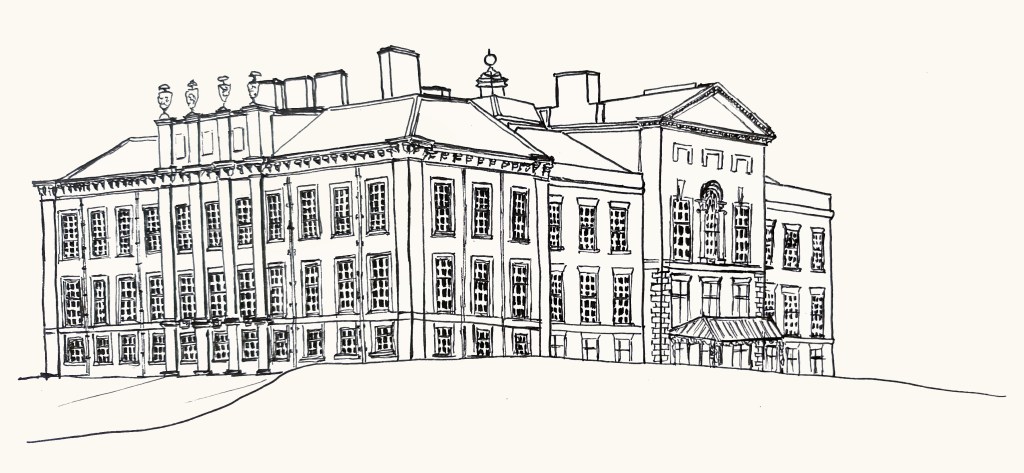
Kensington Palace
The comprehensive re-ordering of the public half of the palace by Historic Royal Palaces to provide a new visitor entrance, hub, shop and café in the existing Grade I listed and scheduled monument and sensitive new extensions. Rowenna developed the client brief through liaison with different departments, worked with the curators to develop the Heritage Statement, prepared the Design and Access Statement and appeal statement. (JSA)
Education Buildings
Peterhouse, Cambridge
Rowenna first worked at Peterhouse to research the histories of the Grade I listed Gisborne Court, Grade II listed Fen Court and Grade II listed Coe Fen wall and prepared Design and Access Statements and Heritage Statements for the refurbishment of Fen Court, the construction of a new range (the Whittle Building) to Gisborne Court, alterations to the Coe Fen wall and the addition of photovoltaic cells to Cosin Court. (JSA)
She subsequently prepared a Heritage Statement for the relandscaping of Cosin Court, which is unlisted but in view of several listed buildings and within the Cambridge City Centre Conservation Area. (Purcell)
Most recently Rowenna researched the history of the Grade I listed Hall, the oldest College building in daily use in Cambridge, and the kitchens, assessed their significance and the heritage impact of a proposed kitchen extension. (RM)
National Gallery, London
Rowenna prepared a Conservation Management Plan with detailed historic development and significance plans as well as area by area recommendations. She has since carried out three updates to reflect recent changes to the building. Rowenna has also prepared the Heritage Statements for the Accommodation Hub project to infill a courtyard and provide new staff accommodation; various refurbishments of individual galleries and spaces; and co-authored the Heritage Statement for the NG200 project to provide an enhanced entrance and a new resource centre. (Purcell)
Queen Mary University London
Rowenna has prepared several Heritage Statements to accompany listed building consent applications for the phased refurbishment of the listed Queen’s Building as well as for the extension of the library, new gates in front of the Queen’s Building, a new opening in a former cemetery wall and for sustainability improvements to the GE Fogg Building. (Purcell)
National Portrait Gallery
Rowenna prepared a new Conservation Management Plan for the National Gallery including its offices and archives in separate buildings on Orange Street. This was used as part of the successful Heritage Lottery Fund application. Rowenna also advised on the development of proposals and prepared the Heritage Statement for the Inspiring People project. This involved the creation of a new entrance, the reinstatement of offices as gallery space and the improvement of accessibility. (Purcell)
St John’s College, Cambridge
Rowenna prepared the Heritage Statement for the refurbishment of E Staircase of the magnificent Grade I listed New Court, which included adding in a lift, altering partitions and creating new internal door openings.
Rowenna went on to prepare a Heritage Statement for the regrading of part of Second Court to create ramped access. The archival sources revealed the stone paving laid historically and enabled a match to be specified. Rowenna also advised on the proposals for the creation of a new student hub with café and informal dining hall in Second and Third Courts, Grade I listed buildings dating from the late sixteenth and seventeenth centuries. The project also involved negotiating the relocation of a pair of listed gate piers. Intensive historic research and building fabric analysis was necessary to secure consent from Historic England. (Purcell)
Norwich Castle Museum and Art Gallery
The Grade I listed Norwich Castle is also a scheduled monument and the Norman keep remains a focal point of the city. Rowenna prepared a detailed bespoke report about the transformation of the former prison into a museum in the Victorian period and an analysis of the survival of fabric throughout the building. This report was used by Norfolk Museums Service to inform its lottery-funded Keep project to enhance the entrance and re-present the Keep including a new floor at the Norman floor level and a lift. Rowenna also updated the Conservation Management Plan and gazetteer to support the National Heritage Lottery Fund application for the Keep project. (Purcell)
Gresham’s Pre-preparatory School, Holt, Norfolk
Occupying the multiphase, Grade II listed Old School House, Gresham’s School commissioned a Heritage Statement to accompany an application for listed building consent for internal changes to the main building and the former laundry building to improve the facilities for its pre-prep school in the heart of the historic town of Holt. (Purcell)
Dorset County Museum
The complex site in Dorchester encompasses the listed purpose-built Victorian museum, neighbouring listed shops, a former inn stables, a medieval stone building and a Victorian institute building. Rowenna prepared the Conservation Management Plan to support the Heritage Lottery Fund Round 2 submission. She also prepared the Heritage Statement for the listed building consent application for the transformation of the museum including a large new extension. (Purcell)
Churchill College, Cambridge
The college on the west side of Cambridge was constructed in the 1960s as a memorial to Sir Winston Churchill and the building materials and artworks donated from round the world were a reflection of this. The architectural competition to design the new college was a pivotal moment in the history of modern architecture in Britain and it was won by Sheppard Robson. All the original buildings are now Grade II listed whilst the properties acquired by the College along Storey’s Way are listed or protected by being in the Storey’s Way Conservation Area. Rowenna prepared a bespoke Heritage Appraisal for the whole College site including an account of the history of the buildings, a detailed assessment of the significance of each building, and heritage advice to guide future planning. Rowenna subsequently prepared Heritage Statements for the conversion of the old Oil Store to a series of usable creative spaces and for the installation of photovoltaic panels on the listed buildings. (Purcell)
Nottingham Castle
Nottingham Castle includes 13 listed buildings and two scheduled monuments ranging from the medieval cave system and medieval gatehouse and outer bailey walls to the Baroque ducal palace, the former waterworks and a row of houses containing the Museum of Nottinghamshire Life. Rowenna prepared a Conservation Management Plan to support the Heritage Lottery Fund Round 2 application. She also liaised with the architects regarding the proposed designs for the new visitor centre and new and transformed galleries. Rowenna prepared the Heritage Statement to accompany the listed building and scheduled monument consent applications. (Purcell)
Private Residential
Orford Ness
An extraordinary place, Orford Ness is Europe’s longest shingle spit and highly significant natural habitat. It also contains listed buildings relating to the First World War Royal Flying Corps base and interwar experiments with radar and land-to-sea communications as well as scheduled structures where nuclear bomb casings were tested. Rowenna prepared a comprehensive Conservation Management Plan and gazetteer for the National Trust. (Purcell)
Private country house, Essex
Rowenna prepared a detailed Statement of Significance including a thoroughly researched history for a private, Grade II* listed country house in Essex. The house had formerly been used as a care home and was being restored for residential use by the new owner. The Statement of Significance informed a masterplan for phased works to the house and wider site. Rowenna also prepared Heritage Statements for works including a new kitchen, repairs and refurbishment of the attached ranges, new access arrangements and the conversion of a garden outbuilding. (Purcell)
St Bartholomew’s Hospital North Wing
Bart’s Heritage Trust commissioned a Conservation Management Plan for the Grade I listed, Palladian North Wing designed by James Gibbs and a highly significant building in the history of architecture in the UK. Rowenna prepared the report following archival research including liaison with other architectural historians, site fabric analysis and consultation with staff and other stakeholders. The CMP formed part of a successful National Heritage Lottery Fund Round 2 application to enhance the former hospital building as a visitor attraction, cultural centre and a wellbeing hub for NHS staff. (Purcell)
Timber-framed, thatched residence, Suffolk
Rowenna prepared a Heritage Statement for a Grade II listed timber-framed and thatched dwelling, formerly used as an inn, in Suffolk. Works included a new extension and the conversion of the garage. (Purcell)
St George’s Guildhall, King’s Lynn
Originally a medieval guildhall, the extraordinary Grade I listed building has long associations with theatre before being turned into an arts centre and restaurant. Owned by the National Trust, the leasee, the Borough Council of King’s Lynn and West Norfolk commissioned a Conservation Statement that Rowenna prepared to contribute to a Heritage Lottery Fund submission. (Purcell)
Private house, Norfolk
Rowenna prepared a Heritage Statement for a Grade II listed farmhouse with attached dairy in South Norfolk to accompany a listed building consent application for a contemporary style kitchen/family room extension. (Purcell)
The Halls, Norwich
Grade I listed and scheduled, The Halls is the most complete surviving monastic urban site in England. Its survival is the result of its purchase by the City Corporation in the sixteenth century and subsequent centuries of multiple uses. The Corporation’s successor, Norwich City Council commissioned a bespoke report that combined a Historic Building Recording with a detailed history and assessment of significance to inform their future management of the site. Rowenna was the main author for this report. (Purcell)
Residential Development
Harvey’s Foundry, Hayle
Part of the West Devon and Cornwall Mining World Heritage Site, the historically significant site of Harvey’s Foundry is being re-purposed in phases to bring derelict and disused industrial buildings back into use for visitors, artists and small businesses. Rowenna prepared a Conservation Management Plan and Gazetteer for the whole site to accompany a Heritage Lottery Fund Round 2 application that led to the successful restoration of two roofless, arson-struck, Grade II listed, stone buildings, the Plantation and Pattern Stores. (Purcell)
Colne Place, Earls Colne, Essex
The Grade II listed house stands opposite a Grade I listed church and despite its nineteenth century frontage, the building contains a seventeenth century timber-framed core. Rowenna prepared a heritage appraisal to inform designs for its sensitive conversion from a care home into apartments and prepared the Heritage Statement to accompany the successful listed building consent application. (Purcell)
Abbey of St Edmund, Bury St Edmund
West Suffolk Council, as part of the Abbey of St Edmund Heritage Partnership, commissioned a Conservation Plan for the site of the former Abbey of St Edmund, once a site of international pilgrimage and one of the wealthiest religious foundations in medieval England. The vast site encompasses nearly 140 listed buildings including 21 Grade I listed buildings, two scheduled monuments and a registered park. Rowenna undertook extensive consultation with key stakeholders and staff of different organisations owning and occupying the site. She prepared a detailed assessment of significance of a place where the barons met before the preparation of Magna Carta, assessed each character area in terms of its significance and issues and opportunities, provided a conservation framework with policies and actions and provided suggested interpretation options for the future re-presentation of the site.
Rowenna presented the Conservation Plan to the public at a conference in January 2019.
Former Babergh District Council Offices Development
Rowenna prepared an initial heritage assessment to inform the development of proposals for the redevelopment of the complex of buildings that comprised the former Babergh District Council offices in Hadleigh, Suffolk. The site included five listed buildings ranging from a former cottage to a maltings. Rowenna liaised with the local Historic England inspector regarding the proposals as well with a national Historic England listings officer who considered whether the purpose-built council buildings designed by Arup in the 1970s should also be listed. Rowenna also prepared the final Heritage Impact Assessment for this complex site and helped secure consent for the proposals. (Purcell)
Military/Healthcare Development
Former East Suffolk Council Offices Development
The former East Suffolk Council Offices comprised a much-altered historic red brick house, a late Victorian Italianate villa and several modern phases of building on a sloping site across the River Deben from the Sutton Hoo treasure site. It also sits across the parish boundaries of Woodbridge and Melton, is on the edge of the Woodbridge Conservation Area and has a listed building adjacent to it. Rowenna prepared an initial heritage assessment to inform discussions with the Conservation Officer as well as guiding the development of proposals. She worked closely with the architects to develop a sensitive scheme. (Purcell)
Defence and National Rehabilitation Centre
Stanford Hall in Nottinghamshire contained the Grade II* listed mansion and five other listed buildings set in a Grade II registered park. It was purchased by the Duke of Westminster and gifted to the nation as a new centre for rehabilitation. Rowenna worked extensively on the project for two and a half years. She undertook historic research including collecting local oral history contributions, assessed the significance of the buildings and advised on the heritage impact of different elements from repairs and reuse of the mansion, new extensions and security measures to the relocation of one listed building and demolition of another. Rowenna used the historic research to prepare material for funding appeals. She also prepared the Design and Access and Heritage Statements for the listed building application as well as liaising with the existing departments at Headley Court regarding their requirements. (JSA)
Public Commissions
Hospitality
South Georgia
The remote island of South Georgia in the South Atlantic contains a range of heritage assets from Shackleton’s grave and former whaling stations to shot-down helicopters from the Falklands War and sea vessels, afloat, aground and wrecked. Commissioned by the Government of South Georgia and the South Sandwich Islands, Rowenna prepared a Heritage Framework and Strategy to define the heritage assets and provide a strategy for their future care. She subsequently co-authored a catalogue of all the islands’ heritage assets including an assessment of their significance and guidance on their future conservation. Rowenna also prepared a Conservation Management for the former Grytviken Whaling Station, which involved consultation with people based on South Georgia, the Falkland Islands and in the UK. It provided pragmatic policies and actions that reflected the considerable constraints of the site’s location. (Purcell)
Assembly House, Norwich
The Grade I listed building and scheduled monument combines medieval remains with sixteenth and seventeenth century rebuilding, Thomas Ivory’s eighteenth century assembly rooms and later nineteenth century extensions. Rowenna prepared a series of Heritage Statements for projects on the site. The first was for the redecoration of two of Ivory’s rooms, which involved researching the colour palettes used in the rooms over the centuries and liaising closely with Historic England. The second was for the conversion of second floor offices to hotel bedrooms in the west wing. Rowenna also prepared a report on the undercrofts which include medieval fabric and fabric from every subsequent century.
CWGC Imphal and Kohima
The Commonwealth War Graves Commission maintains three cemeteries that were on the frontline of the Second World War Battles of Imphal and Kohima in India on the border with Myanmar. These large cemeteries face natural threats from earthquakes and monsoon rains that cause landslides as well as a variety of challenges including their remoteness, lack of water, encroachment by development, anti-social behaviour, political instability in the region and their popularity as green spaces within the cities. Rowenna prepared Conservation Management Plans for all three cemeteries, including detailed histories based on archival material in the UK and India, assessments of significance in accordance with ICOMOS principles and pragmatic policies. She liaised with local teams and led a project team including an Indian architect and an Indian landscape expert to oversee the preparation of a condition survey, gazetteer and management and maintenance plan. (Purcell)
Talks
Inspired by the stories of the cemeteries, Rowenna organised two events at which she and others spoke. The first was in Colchester and explored the connection between Kohima War Cemetery and the Essex Regiment. The second was an event to mark the 75th anniversary of the Battle of Kohima at Norwich Castle, which holds a gun captured at the Battle of Kohima, and raised funds for the Kohima Education Trust that was set up by surviving servicemen to thank local people for their aid during the battle. Rowenna also gave a talk on the conservation challenges at the cemeteries for the Commonwealth Heritage Forum.
Worstead Coach House, Norfolk
Designed by James Wyatt, the Grade II listed, eighteenth century coach house and stables is the most substantial surviving historic building on the estate following the demolition of the mansion in the twentieth century. Rowenna worked closely with the client and architect to develop sensitive proposals to transform the disused building into a restaurant with rooms as part of the revitalisation of the estate. After engaging with the local conservation officers, Rowenna prepared the Heritage Statement for the listed building consent application. (Purcell)
Glaven Valley Conservation Area Appraisals
Commissioned by North Norfolk District Council, Rowenna prepared the Conservation Area Appraisals for Cley-next-the-Sea, Wiveton, Brinton, Thornage, Sharrington, Edgefield, co-authored the appraisal for the Glaven Valley, contributed to the appraisals for Hunworth and Stody and reviewed five others. This work included extensive site analysis, liaison with the Council to ensure compliance with its planning policy and public consultation. (Purcell)
 Rowenna Malone Ltd